Top 20 Core Java Interview Questions and Answers (2026)
Practical Core Java interview questions with simple explanations covering OOPS, Strings, Exception Handling, Collections, JVM, and real-world interview scenarios.
👋 Introduction
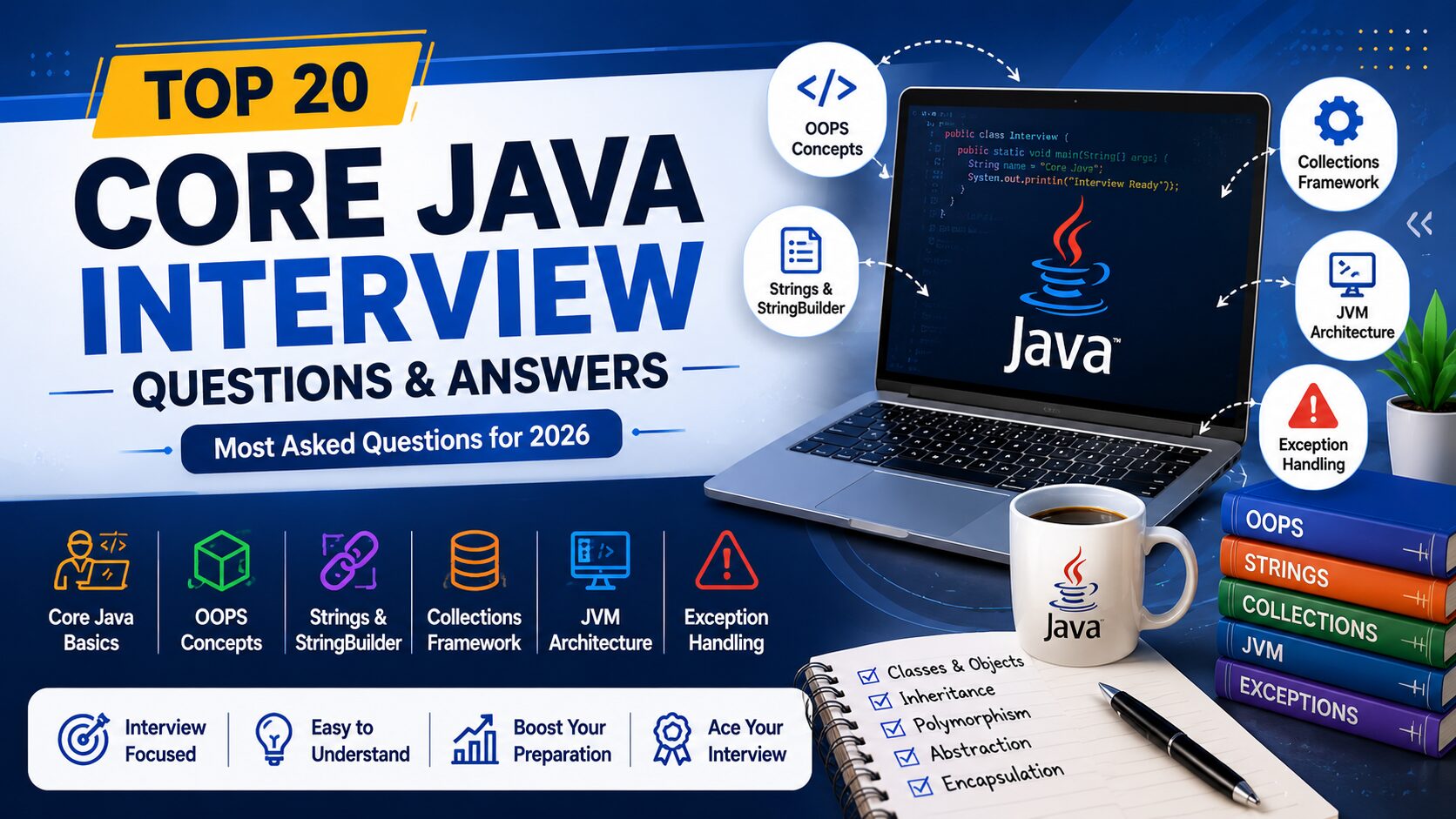
Core Java remains one of the most important topics in software testing, automation testing, and software development interviews. Whether you are preparing for a QA Automation Engineer, SDET, or Java Developer role, interviewers often evaluate your Java fundamentals before discussing frameworks or project experience.
Many candidates spend hours memorizing hundreds of Java questions but still struggle to explain concepts confidently during interviews. In reality, most companies repeatedly ask a smaller set of core concepts such as OOPS, Strings, Exception Handling, Collections, JVM, and Java keywords.
To help you prepare efficiently, this guide covers the most commonly asked Core Java interview questions with practical explanations. The focus is on understanding concepts rather than memorizing definitions, making it useful for both freshers and experienced professionals.
💡 Preparing for QA interviews?
Many QA candidates understand theory but struggle when interviewers ask practical questions related to Test Cases, RTM, Bug Reports, and real project documentation.
To help beginners practice real QA documentation, I created a QA Starter Toolkit with ready-to-use templates used in software testing projects.
👉 Download the QA Starter Toolkit here
🧠 Core Java Basics
1. What is Java?
Java is a high-level, object-oriented programming language developed by Sun Microsystems. It is widely used for building web applications, enterprise systems, Android applications, and automation testing frameworks.
One of Java’s biggest advantages is platform independence, allowing developers to write code once and run it on multiple operating systems.
2. What are the main features of Java?
Some important features of Java include:
✔ Object-Oriented Programming
✔ Platform Independence
✔ Security
✔ Robust Exception Handling
✔ Multithreading Support
✔ Automatic Memory Management
✔ High Performance through JIT Compiler
These features make Java one of the most popular programming languages in enterprise software development.
3. What is the difference between JDK, JRE, and JVM?
JDK (Java Development Kit) is used for developing Java applications.
JRE (Java Runtime Environment) provides the environment required to run Java applications.
JVM (Java Virtual Machine) executes Java bytecode and makes Java platform independent.
A simple way to remember:
JDK = Develop + Run
JRE = Run
JVM = Execute
4. Why is Java platform independent?
Java source code is compiled into Bytecode rather than machine code.
This Bytecode can run on any operating system that has a compatible JVM installed.
Because of this approach, Java follows the principle:
“Write Once, Run Anywhere.”
5. What is JIT Compiler?
JIT (Just-In-Time) Compiler is a component of the JVM.
Instead of interpreting Bytecode line by line every time, JIT converts frequently used Bytecode into machine code during runtime, improving application performance significantly.
🏗️ Classes and Objects
6. What is a Class in Java?
A class is a blueprint used to create objects.
It defines the properties (variables) and behaviors (methods) that objects of that class will have.
For example, a class named Employee can contain attributes such as name and salary, along with methods like calculateSalary().
7. What is an Object in Java?
An object is an instance of a class.
It represents a real-world entity and contains both data and behavior.
For example, if Employee is a class, then John can be an object of that class.
8. What is a Constructor?
A constructor is a special method that is automatically called when an object is created.
It is mainly used for initializing object values.
A constructor must have the same name as the class and does not have a return type.
9. Can a Constructor be overloaded?
Yes.
A constructor can be overloaded by changing the number or type of parameters.
This allows objects to be initialized in different ways depending on business requirements.
10. Difference between Constructor and Method?
Constructor:
✔ Used for initialization
✔ Called automatically during object creation
✔ No return type
Method:
✔ Defines object behavior
✔ Called explicitly
✔ Can return values
🔥 OOPS Concepts
11. What is OOPS?
OOPS (Object-Oriented Programming System) is a programming approach based on objects and classes.
It helps improve code reusability, maintainability, and scalability.
12. What are the four pillars of OOPS?
The four pillars of OOPS are:
✔ Encapsulation
✔ Abstraction
✔ Inheritance
✔ Polymorphism
These concepts form the foundation of object-oriented programming.
13. What is Inheritance?
Inheritance allows one class to acquire properties and methods from another class.
It promotes code reusability and reduces duplication.
Example:
A Car class can inherit common properties from a Vehicle class.
14. What is Polymorphism?
Polymorphism means “many forms.”
It allows the same method to behave differently depending on the object calling it.
Method Overloading and Method Overriding are common examples of polymorphism.
15. What is Encapsulation?
Encapsulation is the process of binding data and methods together into a single unit.
It protects data by restricting direct access and exposing it through getter and setter methods.
16. What is Abstraction?
Abstraction hides implementation details and shows only the essential functionality.
For example, while driving a car, you use the steering wheel and pedals without knowing the internal engine mechanics.
🔤 String Questions
17. Why are Strings Immutable in Java?
Strings are immutable, meaning their values cannot be changed once created.
This improves:
✔ Security
✔ Performance
✔ Thread Safety
✔ Memory optimization through the String Pool
18. Difference between String, StringBuilder, and StringBuffer?
String:
✔ Immutable
StringBuilder:
✔ Mutable
✔ Faster
✔ Not thread-safe
StringBuffer:
✔ Mutable
✔ Thread-safe
✔ Slightly slower than StringBuilder
19. Difference between == and equals()?
== compares memory references.
equals() compares actual content.
In interviews, this is one of the most frequently asked Java questions.
⚠️ Exception Handling
20. What is Exception Handling in Java?
Exception Handling is a mechanism used to manage runtime errors and maintain the normal flow of a program.
Common keywords used are:
✔ try
✔ catch
✔ finally
✔ throw
✔ throws
Proper exception handling improves application reliability and debugging.
🚀 Want to Practice Real QA Documentation?
If you are preparing for QA interviews, practicing real testing documentation can give you a significant advantage over other candidates.
The QA Starter Toolkit includes:
✔ Editable Test Case Template
✔ Requirement Traceability Matrix (RTM)
✔ Bug Report / Defect Tracking Template
✔ Sample filled examples
✔ Beginner-friendly format
👉 Get the QA Starter Toolkit here
📌 Conclusion
Core Java remains one of the most important skills for automation testing, SDET, and software development interviews. Rather than trying to memorize hundreds of questions, focus on understanding the core concepts that interviewers repeatedly ask.
Mastering topics such as OOPS, Strings, JVM, Constructors, and Exception Handling will help you answer questions confidently and demonstrate strong programming fundamentals during interviews.
You May Also Like
👉 Top Software Testing Interview Questions and Answers
👉 Top Selenium Interview Questions and Answers
👉How to Prioritize Test Cases When Requirements Change at the Last Minute (Real QA Guide)
👉 Top SQL Interview Questions and Answers
👉 Top Jira Interview Questions and Answers
👉Top API Testing Interview Questions and Answers


You May Also Like

Top 30 Selenium Interview Questions and Answers (2026)
Top 30 API Testing Interview Questions and Answers (2026)