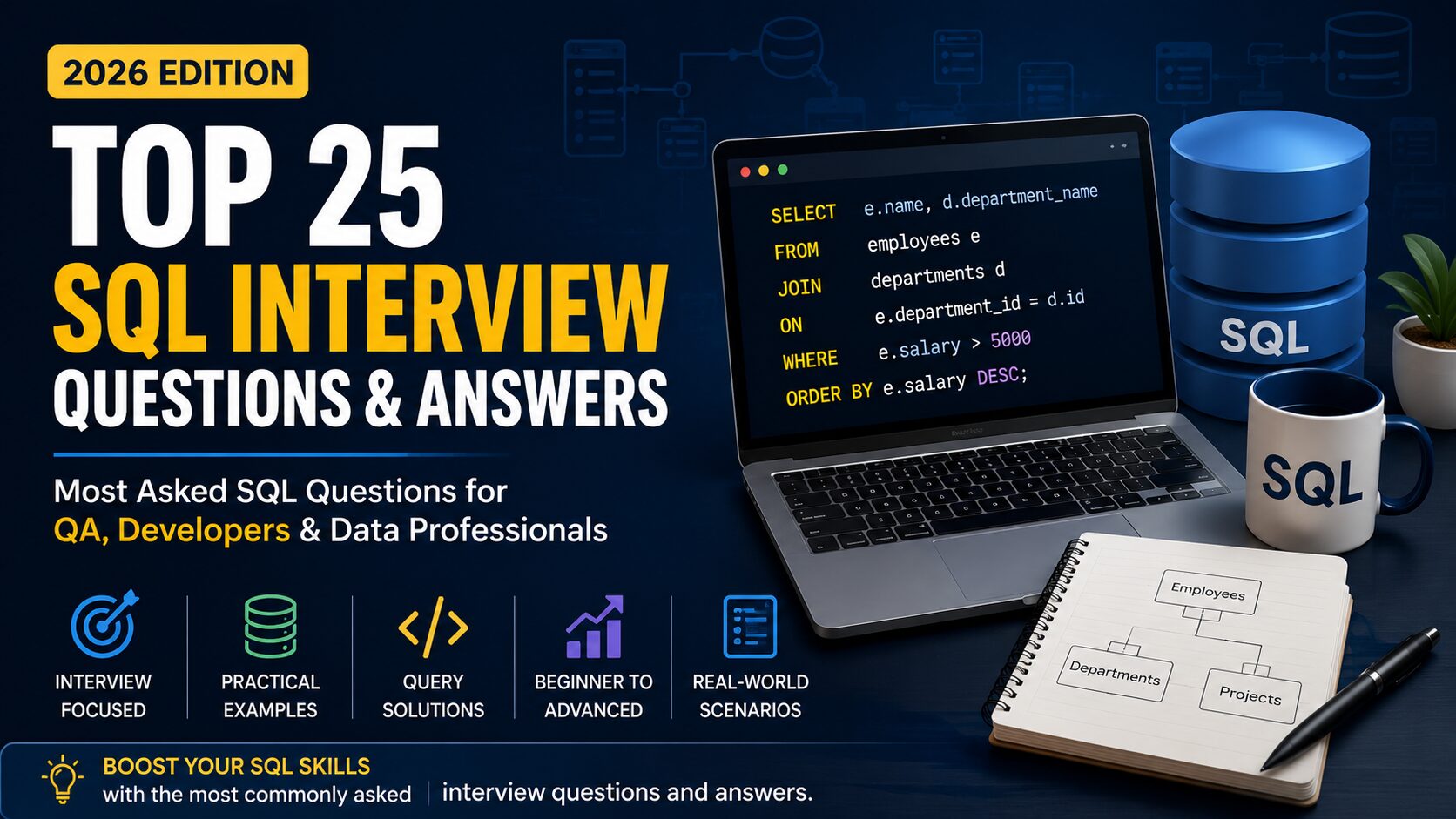
Top 25 SQL Interview Questions and Answers (2026)
Practical SQL interview questions with simple explanations covering Joins, Queries, Database Testing, Keys, Constraints, Normalization, and real-world interview scenarios.
👋 Introduction
SQL is one of the most important skills for Software Testers, QA Engineers, Automation Testers, and Developers. It helps professionals retrieve, validate, and analyze data stored in databases.
In many interviews, candidates are asked SQL interview questions to assess their understanding of databases, queries, joins, and data validation techniques. Therefore, having a solid understanding of SQL can significantly improve your interview performance.
For QA professionals, SQL is especially useful when verifying backend data, validating application updates, and performing database testing. In addition, SQL knowledge helps testers investigate defects more efficiently and communicate effectively with developers.
Whether you are a fresher preparing for your first QA interview or an experienced professional looking for a quick revision, this guide will help you understand the most commonly asked SQL interview questions and answers. Furthermore, the explanations are kept simple and practical so you can easily apply these concepts during interviews and real projects.
💡 Preparing for QA interviews?
Many QA candidates understand testing concepts but struggle when interviewers ask practical questions related to Test Cases, RTM, Bug Reports, and real project documentation.
To help beginners practice real QA documentation, I created a QA Starter Toolkit with ready-to-use templates used in software testing projects.
👉 Download the QA Starter Toolkit here
🧠 SQL Basics
1. What is a Database?
A database is a structured collection of data that allows users to store, retrieve, update, and manage information efficiently. Databases are widely used in applications to store customer information, transactions, product details, and business records.
2. What is SQL?
SQL (Structured Query Language) is a language used to communicate with relational databases. It helps users create, retrieve, update, and delete data stored in database tables.
3. What is RDBMS?
RDBMS stands for Relational Database Management System.
Furthermore, it stores data in tables and establishes relationships using keys and constraints.
For example, popular RDBMS systems include MySQL, SQL Server, PostgreSQL, and Oracle.
4. What is the difference between DBMS and RDBMS?
DBMS stores data without enforcing relationships between tables.
However, RDBMS stores data in related tables and supports keys, constraints, and ACID properties.
5. What are DDL, DML, DCL, and TCL Commands?
DDL (Data Definition Language):
CREATE, ALTER, DROP, TRUNCATE
DML (Data Manipulation Language):
SELECT, INSERT, UPDATE, DELETE
DCL (Data Control Language):
GRANT, REVOKE
TCL (Transaction Control Language):
COMMIT, ROLLBACK, SAVEPOINT
🔗 SQL Joins Interview Questions
6. What are the different types of Joins in SQL?
The most common joins are:
✔ Inner Join
✔ Left Join
✔ Right Join
✔ Full Outer Join
✔ Self Join
Joins are used to combine data from multiple tables based on related columns.
7. What is the difference between Inner Join and Left Join?
Inner Join returns only matching records from both tables.
Left Join returns all records from the left table and matching records from the right table.
8. What is a Self Join?
A Self Join occurs when a table is joined with itself. It is commonly used to retrieve hierarchical data such as employee-manager relationships.
📊 Keys and Constraints
9. What is a Primary Key?
A Primary Key uniquely identifies each row in a table.
In addition, it cannot contain duplicate or NULL values.
10. What is a Foreign Key?
A Foreign Key creates a relationship between two tables and helps maintain referential integrity.
11. What is the difference between Primary Key and Unique Key?
A Primary Key does not allow NULL values.
A Unique Key allows a NULL value (depending on the database system) but still enforces uniqueness.
12. What is a Composite Key?
A Composite Key consists of two or more columns combined to uniquely identify a record.
⚡ SQL Query Questions
13. How do you find the Nth Highest Salary?
This is one of the most frequently asked SQL interview questions.
For example, the solution can be implemented using subqueries, ROW_NUMBER(), RANK(), or LIMIT/TOP depending on the database system.
14. How do you find duplicate records in a table?
Duplicate records can be identified using GROUP BY and HAVING COUNT(*) > 1.
15. How do you remove duplicate records?
Duplicates can be removed using ROW_NUMBER(), Common Table Expressions (CTEs), or DELETE statements with subqueries.
16. How do you fetch Top N records?
Top records can be fetched using:
LIMIT (MySQL)
TOP (SQL Server)
ROWNUM (Oracle)
17. How do you find odd and even rows?
Odd and even rows can be retrieved using ROW_NUMBER() and checking the remainder with the modulo (%) operator.
🗄️ Database Normalization
18. What is Database Normalization?
Normalization is the process of organizing data to reduce redundancy and improve data integrity.
19. What is First Normal Form (1NF)?
Each column should contain atomic values, and repeating groups should be removed.
20. What is Second Normal Form (2NF)?
The table must satisfy 1NF, and all non-key columns should depend on the entire primary key.
21. What is Third Normal Form (3NF)?
The table must satisfy 2NF and remove transitive dependencies.
🔄 Transactions and ACID Properties
22. What is a Transaction?
A transaction is a logical unit of work consisting of one or more SQL operations executed together.
As a result, all operations either succeed completely or fail together.
23. What are ACID Properties?
ACID stands for:
✔ Atomicity
✔ Consistency
✔ Isolation
✔ Durability
These properties ensure reliable database transactions.
24. What are Locks in SQL?
Locks help maintain data consistency when multiple users access the same data simultaneously.
🚀 Advanced SQL Questions
25. What are Stored Procedures and Triggers?
Stored Procedures are reusable SQL programs stored in the database.
Triggers are special procedures that automatically execute when specific database events occur.
🚀 Want to Practice Real QA Documentation?
Interview questions are important, but many QA candidates struggle when interviewers ask about practical project documents such as Test Cases, RTM, and Bug Reports.
To help beginners understand real QA work, I created a QA Starter Toolkit that includes ready-to-use templates commonly used in software testing projects.
The toolkit includes:
✔ Test Case Template
✔ Requirement Traceability Matrix (RTM)
✔ Bug Report Template
✔ Sample Filled Examples
✔ Beginner-Friendly Format
👉 Download the QA Starter Toolkit here
📌 Conclusion
SQL remains one of the most important skills for QA Engineers, Automation Testers, and Developers. Understanding concepts such as Joins, Keys, Constraints, Transactions, and Query Writing can significantly improve your interview performance and help you work more effectively with databases in real projects.
Therefore, focus on understanding the concepts rather than memorizing answers. With regular practice, you’ll be able to solve SQL interview questions confidently and perform database validation tasks more efficiently.
You May Also Like
👉 Top Software Testing Interview Questions and Answers
👉 Top Selenium Interview Questions and Answers
👉 Top Core Java Interview Questions and Answers
👉How to Prioritize Test Cases When Requirements Change at the Last Minute
👉 Top Jira Interview Questions and Answers


You May Also Like

Top 30 Selenium Interview Questions and Answers (2026)

Top 100 Software Testing Interview Questions (2026) – Real QA Answers + Examples